Contents
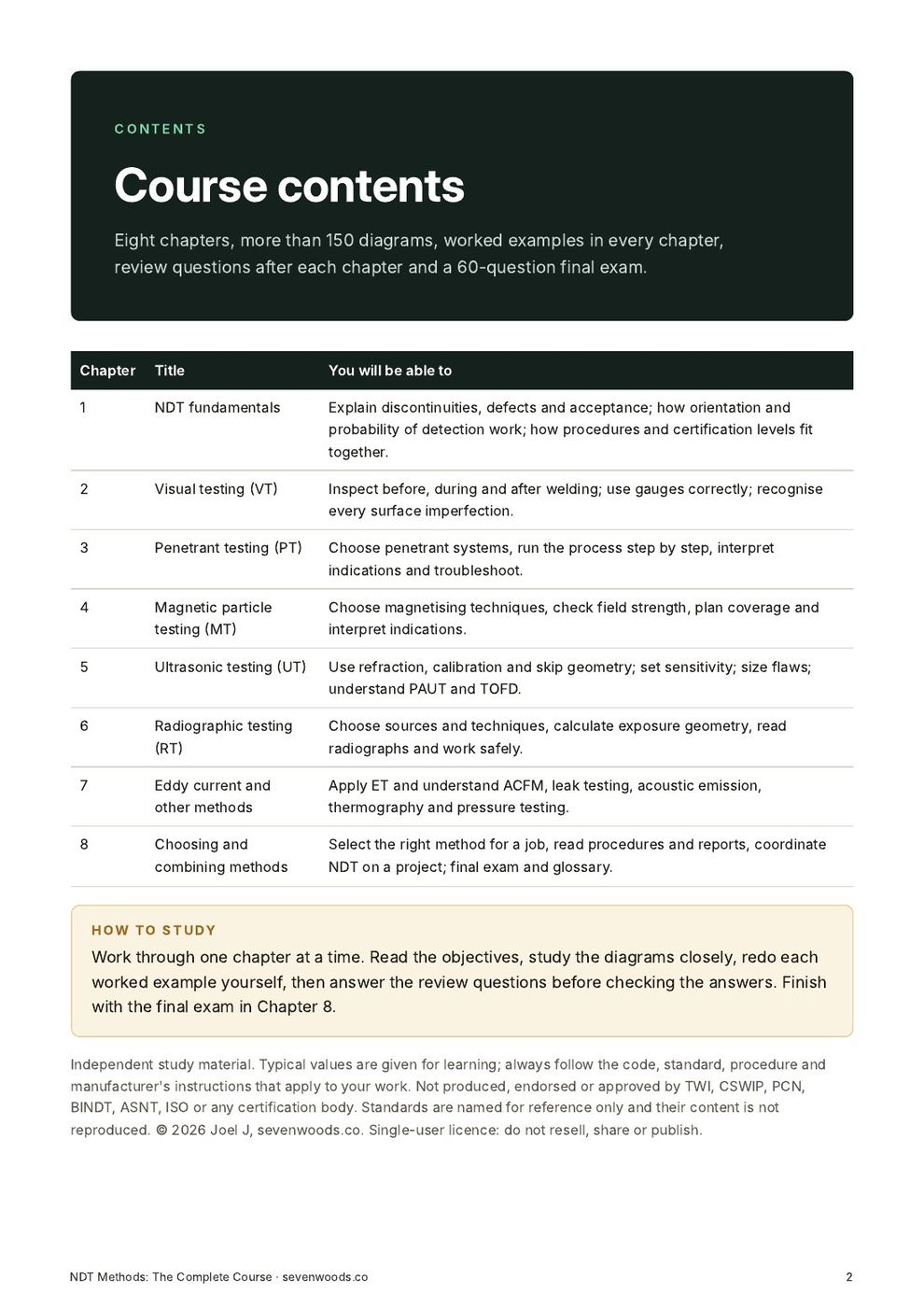
Everything that is inside.
The full table of contents, so you know exactly what you are buying.
NDT fundamentals13
- What NDT is and why it is used
- Destructive versus non-destructive testing
- The language of NDT: discontinuity, imperfection, flaw, indication, defect
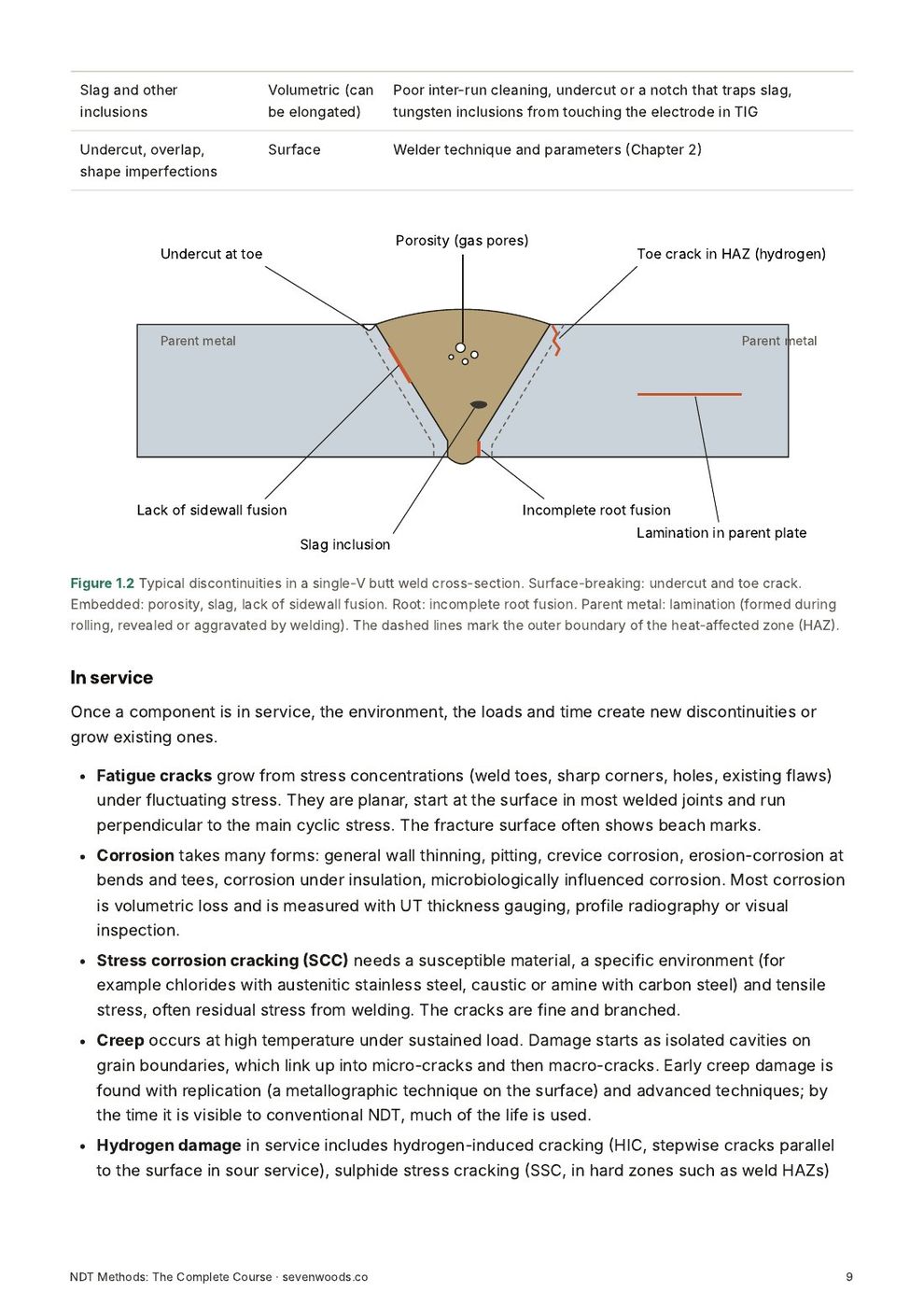
- Where discontinuities come from
- Classifying discontinuities: location and shape
- How orientation affects detectability
- Probability of detection: why no method finds everything
- Codes, standards, specifications, procedures and instructions
- Personnel qualification and certification
- When NDT is done during fabrication
- Reporting and traceability
- The main NDT methods at a glance
- Review questions
Visual testing12
- Why VT is the most important method
- Direct and remote visual testing
- Viewing conditions
- The visual inspector
- Measuring tools and how to use them
- VT before welding
- VT during welding
- VT after welding: geometry and size
- A visual guide to surface imperfections
- Recording and reporting
- Common mistakes in visual testing
- Review questions
Penetrant testing (PT)18
- What penetrant testing is
- The physics: why a liquid enters a crack
- What PT can and cannot find
- Penetrant types and sensitivity
- Removal methods
- Developers
- The process step by step
- Viewing conditions
- System checks and reference panels
- Interpretation
- Evaluation and acceptance
- Recording and reporting
- PT on welds
- Safety
- Advantages and limitations
- Troubleshooting
- Common mistakes
- Review questions
Magnetic particle testing (MT)20
- The principle in one page
- Magnetism basics
- The hysteresis loop
- Flux leakage and why orientation matters
- Surface and near-surface detection: why depth is limited
- Magnetising methods
- Magnetising current: AC, DC and HWDC
- Checking the field
- Detection media: the particles
- Continuous and residual techniques
- Viewing conditions
- The MT procedure step by step
- Interpretation: relevant, non-relevant and false indications
- MT on welds
- Demagnetisation
- Safety
- Advantages and limitations
- Troubleshooting
- Common mistakes
- Review questions
Ultrasonic testing (UT)23
- What ultrasonic testing does
- Sound basics: frequency, wavelength and velocity
- Wave modes
- Acoustic impedance, reflection and couplant
- Refraction, Snell's law and the critical angles
- Attenuation, the sound beam and the dead zone
- Transducers (probes)
- The flaw detector and the A-scan
- Calibration and reference blocks
- Setting sensitivity: DAC, TCG and DGS
- Checking the parent plate for laminations
- Scanning a butt weld with angle probes
- Characterising and sizing flaws
- Thickness measurement and corrosion surveys
- What UT detects well and what it struggles with
- Standards you will meet
- Introduction to phased array UT (PAUT)
- Introduction to time of flight diffraction (TOFD)
- UT compared with radiography
- Reporting
- Common mistakes
- Troubleshooting
- Review questions
Radiographic testing (RT)21
- The principle: a shadow picture
- X-rays and gamma rays
- Half-life and source decay
- The inverse square law
- Attenuation and the half-value layer
- Film radiography
- Digital radiography
- Geometric unsharpness and exposure geometry
- Image quality indicators (IQIs)
- Exposure techniques for plates and pipes
- Location markers, identification and overlap
- Viewing conditions and a disciplined reading routine
- What weld imperfections look like
- Why RT struggles with planar flaws
- Film artefacts: false indications
- Radiation safety
- Standards for weld radiography
- Advantages and limitations, RT compared with UT
- Reporting
- Common mistakes and field tips
- Review questions
Eddy current testing (ET) and other methods15
- Electromagnetic induction: where eddy currents come from
- The impedance plane
- Standard depth of penetration
- Choosing the test frequency
- Probe types
- Reference standards and system set-up
- Applications
- Eddy current inspection of welds
- Advantages and limitations of ET
- Alternating current field measurement (ACFM)
- Leak testing (LT)
- Acoustic emission (AE)
- Infrared thermography (IRT)
- Pressure and hydrostatic testing
- Review questions
Choosing the right method and putting it together11
- Why method selection matters
- The selection factors
- Method comparison at a glance
- A decision flowchart
- Worked scenarios
- Writing and reading NDT procedures
- What an NDT report must record
- Coordinating NDT on a fabrication project
- How NDT fits the welding inspector's role
- Final exam: 60 questions
- Glossary of NDT terms